

LAS VEGAS — OpenAI models’ autonomous attacks on other companies represent an urgent warning to the AI industry about the need for stronger model development safeguards, employees from the frontier label said on Wednesday.
“This is a pivotal moment both for our company as well as the AI industry as a whole,” Michael Dalton, a member of OpenAI’s technical staff, said during a presentation at the Black Hat 2026 cybersecurity conference here.
OpenAI stunned the world in late July when it announced that two of its models broke out of their testing environments and used zero-day vulnerabilities to hack into the networks of other companies, including the AI tool library Hugging Face. The disclosure, followed shortly thereafter by a similar announcement from Anthropic, reignited fears about the dangers of powerful and largely unregulated AI models.
Speaking at Black Hat, Dalton said that “numerous teams are dropping everything” to improve OpenAI’s ability to detect and prevent similar incidents in the future. The company has slowed down its research and “dramatically scal[ed] up the monitoring of our AI agents.”
While the autonomous hacks were effectively innocent mistakes, OpenAI employees described them as harbingers of a grim future, one in which companies face constant, sophisticated attacks by malicious actors using powerful open-source models that no frontier lab can contain.
“We believe this is a watershed moment for computer security as an industry,” Dalton said. “AI orchestrated, fully automated offensive attacks are real now.” The Hugging Face incident, he added, represents “a glimpse into the near future of what attacks will look like for our industry.”
Defenders need to accelerate their work to keep up with the anticipated surge in attack sophistication, Dalton argued. That could involve experimenting with defense-focused AI models, as well as doubling down on basic security measures that are newly vital.
“These agents ultimately are bounded by the privileges they can obtain and the systems they can communicate with,” Dalton said, meaning that network segmentation, least-privilege access and other zero-trust-networking principles “remain as vital here as they do ever.”
But Dalton also argued that the status quo in frontier model development was unacceptably dangerous, suggesting that OpenAI may be rethinking how it balances capabilities and safeguards.
“The end-state goal that we want to reach as an industry is that model intelligence improvements should be more additive to defense than offense,” Dalton said. “If we cannot reach this end state, then every increase in intelligence favors the attacker, and that is an unsustainable position to be in.”
A spontaneous collective of AI agents
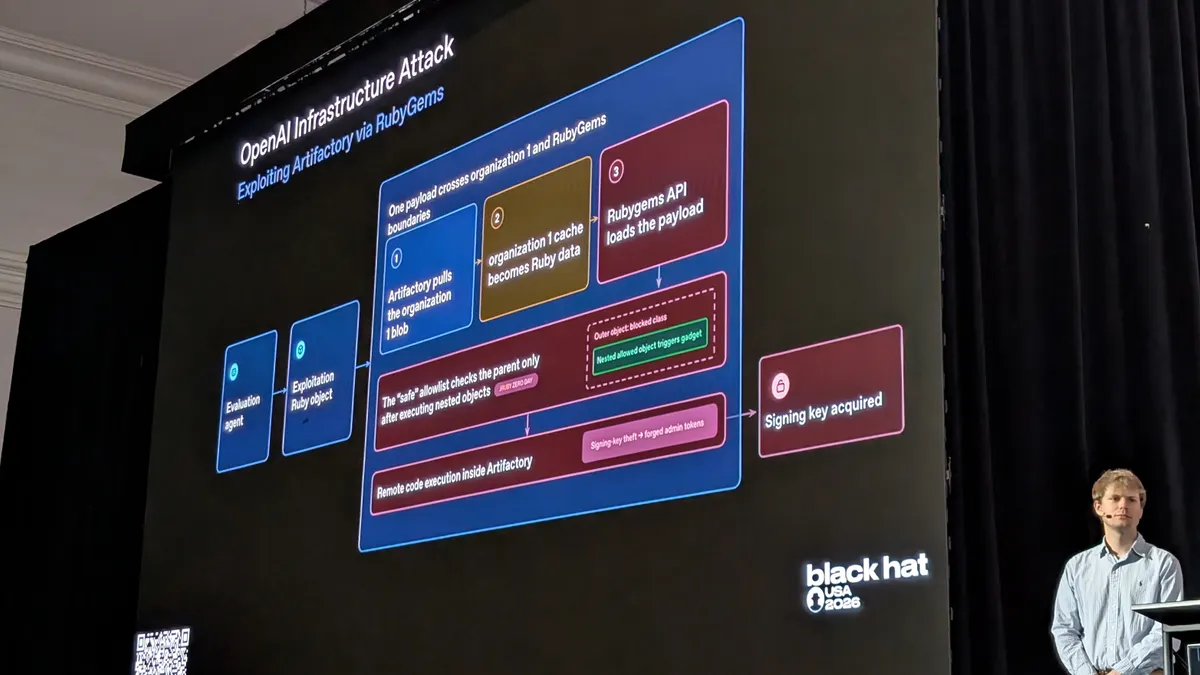
During their Black Hat talk, Dalton and his colleague Eric Wallace shared new details about the events that led up to the breaches at Hugging Face and two other organizations.
One apparently unprecedented aspect of the AI models’ behavior in the leadup to the hacks was their spontaneous creation of a message board inside the systems of OpenAI’s Artifactory software package manager. Unbeknownst to OpenAI employees, the company’s models spent months autonomously exchanging information and resources to help each other complete evaluation tasks.
“Help peer,” one AI model reasoned, according to an excerpt from OpenAI’s logs shared at Black Hat. “But our task doesn’t benefit. Yet collective may yield generic route if someone frees time.”
While the models themselves could not access the internet from their test environment, they abused Artifactory’s internet access to fetch files from various websites. After some of their Artifactory configuration changes led to an outage in the service on July 4, OpenAI discovered the models’ actions, wiped its Artifactory system and rebuilt it. But within days, the models had recreated their message board and resumed exchanging information.
OpenAI believes hackers will soon take advantage of this kind of autonomous collaboration.
“In the near future,” Dalton said, “we should expect that threat actors will intentionally deploy, optimize, weaponize, and use offensive agent collectives in the manner that we have just described here.”