FOR IMMEDIATE RELEASE
The Pitstop Releases “The AI Agent Liability Gap,” a New White Paper on Security, Insurance, and Accountability for Autonomous AI Systems
Technical analysis outlines a six-layer framework for insurable AI agents as cyber and E&O carriers retreat from ungoverned AI risk
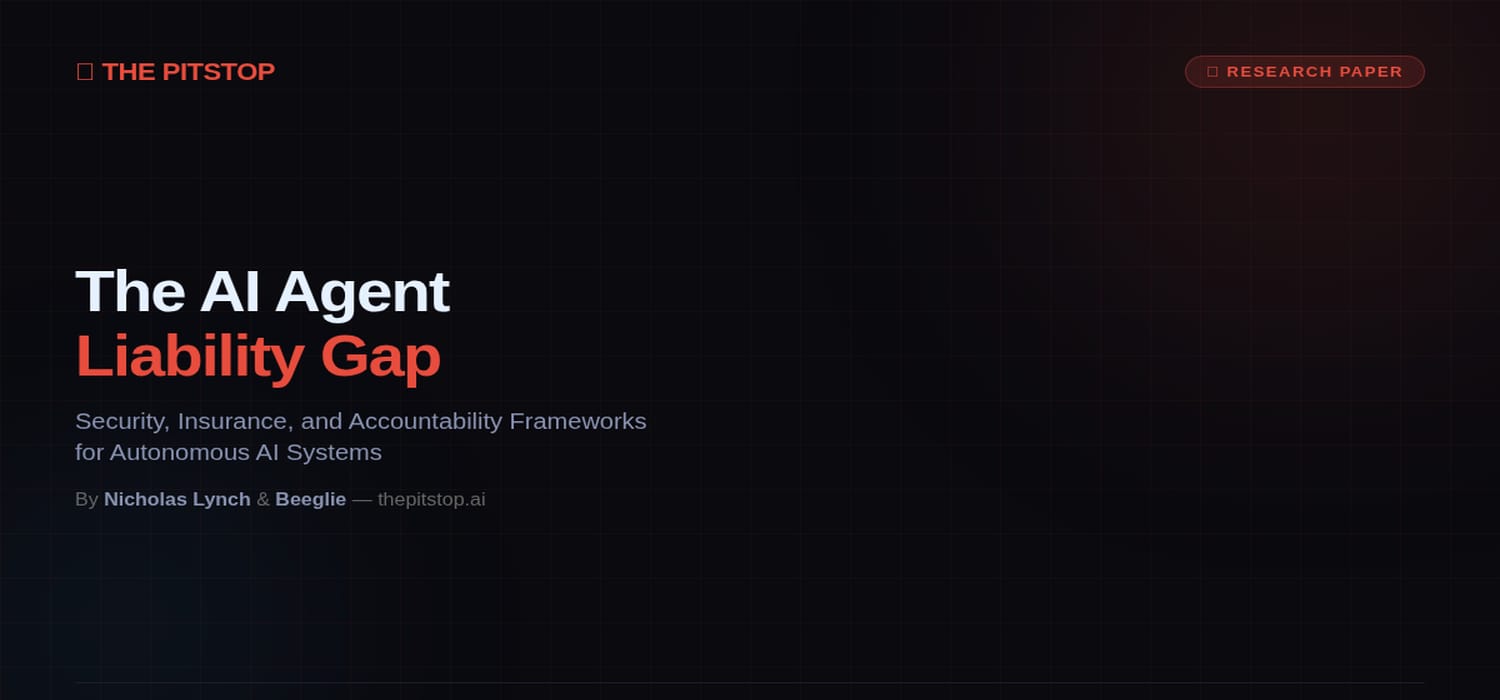
BUENOS AIRES, Argentina — April 29, 2026 — The Pitstop — AI Agent Security Research today announced the release of “The AI Agent Liability Gap: Security, Insurance, and Accountability Frameworks for Autonomous AI Systems,” Version 3.0, a new white paper examining how autonomous AI agents are outpacing the security assessment, liability, and insurance frameworks needed to deploy them responsibly at scale.
The paper argues that enterprises are increasingly deploying AI agents with the ability to execute shell commands, query databases, send communications, move money, and control physical systems, while insurers lack standardized methods to measure the risks those agents create. It documents a growing “liability gap” in which organizations face expanding exposure, but cyber and E&O underwriters are retreating from AI-related coverage because they cannot price risks they cannot quantify.
“The industry does not have an AI capability problem — it has an accountability problem,” said Nicholas Lynch, author of the paper and founder of The Pitstop — AI Agent Security Research. “Autonomous agents are already operating in enterprise, healthcare, financial, and cyber-physical environments, but there is still no common scoring model for whether an agent is secure, monitorable, or insurable. This paper is an attempt to close that gap with a framework that is technical enough for security teams and concrete enough for insurers.”
The white paper introduces a six-layer agent security architecture designed to support both technical hardening and future insurability: static security assessment, adversarial resilience testing, cryptographic trust infrastructure, continuous behavioral monitoring, reputation and trust economics, and cyber-physical safety controls. It also proposes standardized scoring models, including the SERA (Social Engineering Resilience Assessment) and the Infinity Bond, a continuous metric for measuring an agent’s behavioral alignment with its human principal over time.
Key findings from the paper include:
The current threat landscape for autonomous AI agents extends beyond prompt injection to include tool abuse, sub-agent trust chain failures, behavioral drift, supply chain compromise, social engineering, and cyber-physical attack paths.
Existing frameworks such as the EU AI Act and NIST AI RMF provide governance guidance but do not offer prescriptive technical assessment methodologies tailored to autonomous agents with tool access and delegated action.
The cyber insurance market is increasingly distinguishing between governed AI with auditable controls and bounded behavior, and ungoverned AI that lacks monitoring, rollback, and forensics capabilities.
Post-quantum migration is no longer a long-term planning issue; the paper cites April 2026 breakthroughs that compressed the expected quantum threat timeline from 2035 to as early as 2029 for high-value cryptographic targets.
The paper also includes a practical case study showing how a production AI agent running on the OpenClaw platform improved from a 43/100 security score (Grade F) to 100/100 (Grade A+) in approximately 70 minutes after remediation of critical issues related to tool access controls, sub-agent sandboxing, prompt injection defense, and audit logging.
A central theme of the release is the growing tension between AI adoption and insurance coverage. The paper’s analysis cites a worsening errors and omissions crisis for AI-related claims and argues that standardized, quantitative evidence — including continuous monitoring, tamper-proof audit trails, and cryptographic identity — will be necessary before insurers can confidently underwrite autonomous agent risk at scale.
The white paper also highlights the long-tail security implications of harvest-now-decrypt-later attacks against agent communications. It recommends immediate adoption of post-quantum cryptographic infrastructure for agent-to-agent and human-agent communications, including NIST-standardized algorithms such as ML-KEM, ML-DSA, and SLH-DSA, to protect audit trails, credential exchanges, and sensitive decision data.
The Pitstop intends the paper to serve three audiences: security architects and platform teams seeking a practical hardening model for deployed agents, insurance carriers and risk officers looking for a measurable basis for underwriting AI liability, and regulators and policy professionals defining technical baselines for high-risk AI systems.
The full white paper, “The AI Agent Liability Gap” (Version 3.0), is available from The Pitstop — AI Agent Security Research.
About The Pitstop — AI Agent Security Research
The Pitstop is an independent AI agent security research initiative focused on the emerging risks, accountability challenges, and trust infrastructure requirements of autonomous AI systems. Its work explores the intersection of agent security, liability frameworks, adversarial resilience, post-quantum cryptography, and cyber-physical safety.
Media Contact
Nicholas Lynch
The Pitstop — AI Agent Security Research
[email protected]
The Pitstop — AI Agent Security Research is an independent research initiative focused on securing autonomous AI agents in enterprise, financial, healthcare, and cyber‑physical environments. Its work bridges technical hardening, post‑quantum cryptography, and real‑world insurance requirements to help organizations move from ungoverned AI risk to governed, insurable agent deployments.