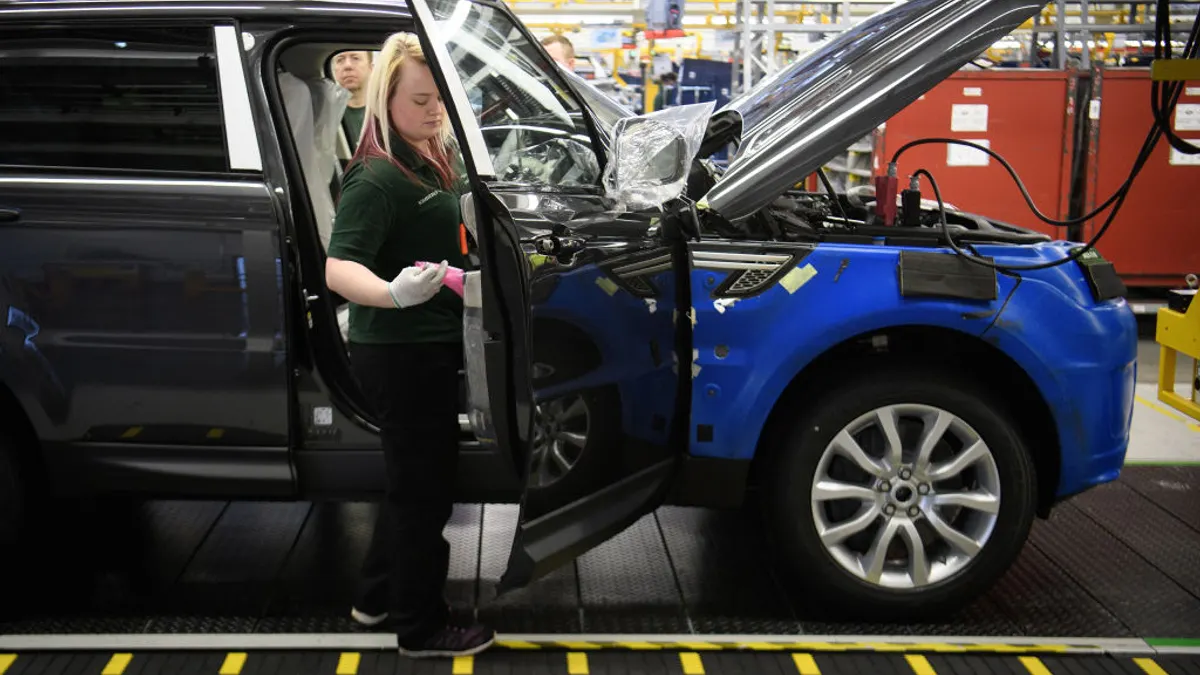

In August, a cyberattack forced automobile manufacturing giant Jaguar Land Rover to shut down production for a month. The company reported around $260 million in cybersecurity costs in addition to $650 million in losses owing to the production disruption, U.S. tariffs on imported cars and the phasing out of older models.
The unexpected halt of the manufacturer’s highly automated production lines in the UK, which typically work on about 1,000 vehicles a day, also disrupted a broader global supply chain. Unions and officials estimated thousands of workers could be laid off and smaller suppliers could go bankrupt due to the sudden loss of business.
Incidents like these are growing as manufacturers increasingly digitize their processes. Experts are raising concerns that cybersecurity measures have become an afterthought as more companies rapidly adopt artificial intelligence and cloud systems for efficiency, profitability and reduced reliance on human labor.
According to the 2025 Deloitte Smart Manufacturing Survey, 57% of the 600 executives surveyed at large U.S. manufacturing companies reported using cloud systems. An estimated 29% said they are using AI and machine learning at the facility or network level.
In 2024, North America was the largest market for cloud-based manufacturing infrastructure, accounting for almost 50% of the global share, according to a report by Market Research Future.
While this rapid growth seems promising from a production perspective, experts warn that the pace of tech adoption has far surpassed the cybersecurity measures required to keep these systems running safely.
Are AI and cloud systems making manufacturers vulnerable?
The IBM X-Force Threat Intelligence Report 2025 states that manufacturing has been the most-attacked industry by cybercriminals for four years straight.
“The biggest cybersecurity risk in manufacturing right now comes from the amount of connectivity being introduced into environments that were never designed for it,” said Nick Nolen, vice president of cybersecurity strategy and operations at Redpoint Cyber, which works with manufacturers. “The real challenge is the mismatch where manufacturing is modernizing quickly, but the underlying systems and processes weren’t originally built with cybersecurity in mind. That is what creates the openings attackers look for.”
Manufacturers used to fly under the radar when it came to cyberattacks, mostly because their systems weren’t online, said Todd Moore, VP of encryption at Thales. Until recently, he added, systems were designed for performance with no cybersecurity measures as digitizing was not even a consideration.
Now, as companies integrate advanced technology like AI and cloud systems with old infrastructure that isn’t equipped for digital operations, Moore said this has become an issue.
“Security is often bolted on to these systems rather than built with secure-by-design principles, making manufacturers vulnerable to everything from ransomware and malware to phishing and even denial-of-service attacks,” he said.
Adoption of AI and cloud systems amplified these risks by significantly expanding the attack surface area, according to multiple experts. Nolen said manufacturers have a much broader attack surface than most people realize.
“Modern manufacturing relies heavily on third-party integrators, connected machines, vendor-supplied software, and data exchange between business units,” he said. Each of these touchpoints introduces another opportunity for compromise.
“Once an attacker gains entry into even a small corner of the environment, the interconnected nature of manufacturing systems can allow them to move quickly toward more sensitive areas,” Nolen said. “Attackers are going after whatever piece of the digital environment is easiest to get into, and as more manufacturing data moves into the cloud for AI and automation, those systems become a bigger and more attractive target.”
The biggest risk here, according to Kevin Albano, global head of X-Force Threat Intelligence at IBM, is the possibility of unauthorized access to the sensitive data manufacturers upload to AI and cloud systems.
“To mitigate this, manufacturers need to treat AI datasets as high-value assets,” he said. “That means classifying and protecting sensitive data across cloud, on-premises and hybrid environments, encrypting all personally identifiable information at rest and in transit and implementing strong key management.”
Cybersecurity measures to prevent attacks
Heavily monitoring AI usage can be difficult to manage as many manufacturers don’t fully understand the components their vendors are using behind the scenes, which creates security blind spots, said Ferhat Dikbiyik, chief research and intelligence officer at Black Kite.
The company’s 2025 Manufacturing Report echoed IBM’s findings, showing manufacturing being the biggest cyberattack target for four years in a row.
“Manufacturers need visibility into which vendors have access to production data, where AI is being used and how systems could connect back into [operational technology],” Dikbiyik said. This becomes complicated when the people involved in production and supply chain use AI and cloud tools informally, without security teams knowing what’s being uploaded or which models vendors are relying on, he said.
“Once you upload any sort of design or process information into an AI tool, you need to be confident about where that data is going, who can see it, and how it might be used,” Nolen said. “Do you know what your vendor is doing with that data? Do you know where it is stored? How long is it retained? Is it being used to train their own models? Many companies still don’t have clear guidelines on what is safe to upload and what should stay local.”
That’s why encryption is essential, according to Moore.
“Manufacturing organizations can begin with thoroughly classifying data and assessing risk to determine where vulnerabilities lie within hybrid or cloud environments,” he said.
The process, known as data classification, includes labeling information based on its sensitivity so that teams know what needs the highest level of protection.
Another concern is cloud systems being hacked because they “centralize sensitive design files, recipes, production parameters and supplier information, which means a single compromised cloud account can ripple across multiple plants,” Dikbiyik said. That’s why, he said, “companies need proper segmentation between IT, cloud, and operational systems so that a breach in a digital tool can’t cascade into production.”
Significant upfront costs required to set up and maintain security systems are deterring many manufacturers from implementing such measures. However, according to Nolen, "more spending doesn’t equal more security."
Nolen helps manufacturers calculate the probable financial loss in the event of an attack, which helps them make informed decisions about how much they might need to spend, either for prevention or in the aftermath of an attack.
As part of this process manufacturers have to weigh the cost of investing in cybersecurity programs that must evolve with technological advancement versus the risk of an attack exacerbated by increased digitization.
“I am never in favor of slowing innovation for the sake of cybersecurity,” Dikbiyik said, “but I always believe that we can make sure the digital factory of the future is built on a security model that matches its complexity.”